If you are running a Shopify store in 2026 and relying solely on paid ads to drive traffic, you are building on rented land. One algorithm change, one budget cut, one rising CPC and your traffic disappears overnight.
Meanwhile, your competitors who invested in SEO are getting free, compounding traffic every single day. The gap between SEO-optimized Shopify stores and those ignoring it is widening fast.
This guide walks you through exactly how to audit your Shopify store for SEO what to check, what most stores get wrong, and how to fix every gap we find. We have audited 38+ Shopify brands and the same problems show up in almost every single one.
Why SEO Matters More Than Ever for Shopify Sellers
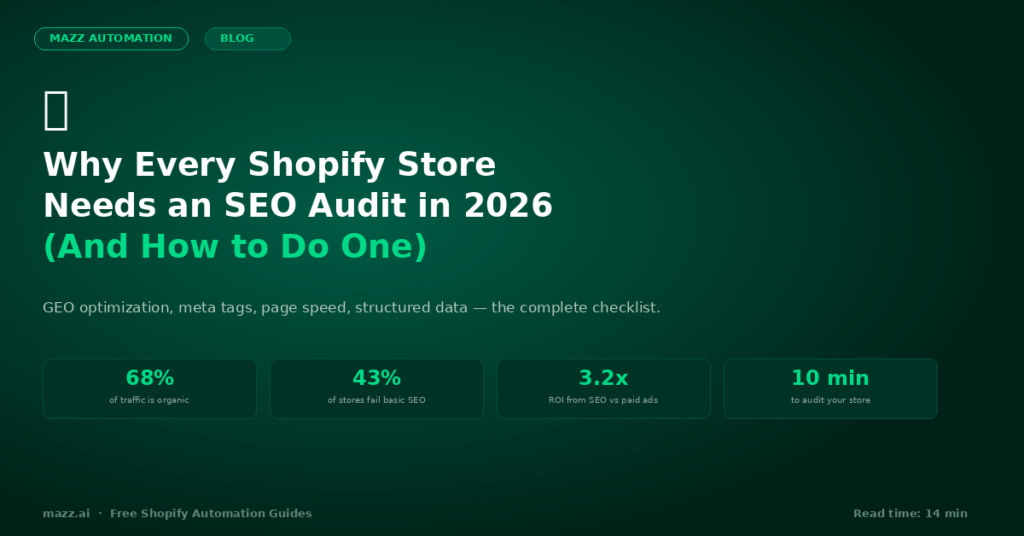
68% of all online experiences start with a search engine. More than half of all website traffic comes from organic search. And here is the number that should scare you: results on page 2 of Google get a 0.63% click-through rate. If you are not on page 1, you are invisible.
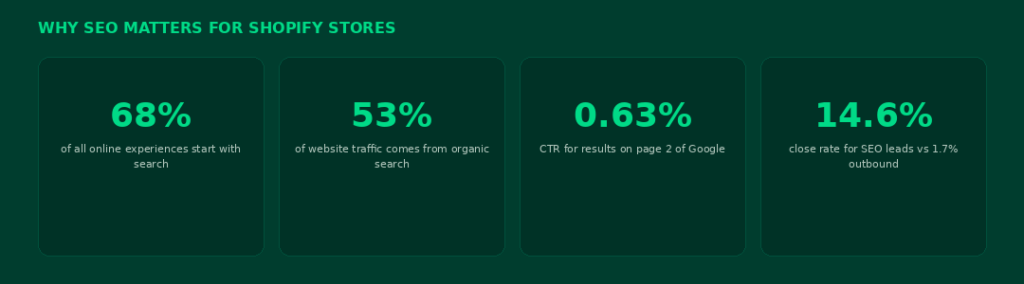
For Shopify stores specifically, organic search delivers leads that convert at 14.6% compared to 1.7% for outbound marketing. That is not a small difference. That is the difference between a profitable store and one bleeding money on ads.
The best part? Once you rank, the traffic is free. No cost per click. No daily ad budget. It compounds over time instead of disappearing when you stop paying.
What a Shopify SEO Audit Actually Covers
A proper SEO audit is not just checking if you have meta titles. It is a systematic review of every factor that determines whether Google shows your store to people searching for your products. Here are the 10 dimensions we audit for every Shopify brand we work with.
1. Meta Titles (Weight: 15%)
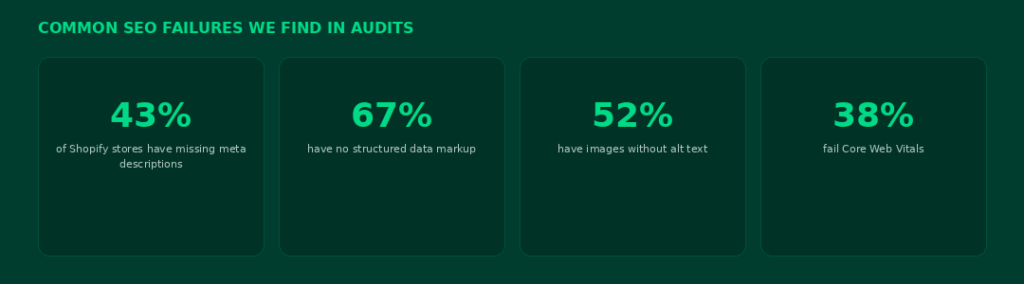
Your meta title is the single most important on-page SEO element. It is what appears as the blue clickable link in Google search results. Yet 43% of Shopify stores we audit have meta titles that are either missing, duplicated across multiple pages, or stuffed with keywords in an unnatural way.
What we check:
- Every page has a unique meta title
- Titles are under 60 characters (so they do not get cut off in search results)
- Primary keyword appears naturally in the title
- Titles are compelling enough to earn clicks (not just keyword-stuffed)
- Homepage, collection pages, and product pages all have distinct titles
Common Shopify mistake: Using the default Shopify title format which appends your store name to every page, eating up your 60-character limit. For example: “Blue Running Shoes YourStoreName” wastes 17+ characters on branding that does not help you rank.
Quick fix: Go to each product and collection in Shopify, scroll to “Search engine listing preview,” and write a custom meta title that leads with your target keyword and stays under 60 characters.
2. Meta Descriptions (Weight: 10%)
Meta descriptions do not directly affect rankings, but they massively affect click-through rate. A well-written meta description can double your CTR from search results which indirectly boosts your rankings because Google sees more people clicking your result.
What we check:
- Every page has a unique meta description
- Descriptions are between 120-160 characters
- They include a clear value proposition or call to action
- They contain the target keyword naturally
- They are not duplicated across products or collections
Common Shopify mistake: Leaving meta descriptions blank and letting Google auto-generate them from page content. This results in ugly, cut-off snippets that nobody wants to click.
3. Heading Structure (Weight: 10%)
Google uses heading tags (H1, H2, H3) to understand the structure and topic hierarchy of your page. A proper heading structure tells search engines exactly what your page is about and how the content is organized.
What we check:
- Each page has exactly one H1 tag (the main title)
- H2 tags are used for major sections
- H3 tags are used for subsections within H2s
- No heading levels are skipped (H1 → H3 without H2 is wrong)
- Keywords appear naturally in at least one heading
Common Shopify mistake: Many themes use H1 tags for the store name in the header, which means product pages end up with the product name as an H2 or worse. This confuses Google about what the page is actually about.
4. Image Alt Text (Weight: 10%)
Every image on your Shopify store is an SEO opportunity. Alt text tells Google what the image shows, helps you rank in Google Image Search, and improves accessibility. Over 52% of Shopify stores we audit have images with missing or generic alt text.
What we check:
- Every product image has descriptive alt text
- Alt text includes relevant keywords naturally (not stuffed)
- Alt text describes what is actually in the image
- Decorative images are properly marked
- Collection banner images have alt text
Common Shopify mistake: Using file names as alt text (“IMG_3847.jpg”) or using the same alt text for every image (“blue shoes blue shoes blue shoes”). Both hurt your SEO.
5. Page Speed and Core Web Vitals (Weight: 20%)
Page speed is a confirmed Google ranking factor. Since 2021, Core Web Vitals Largest Contentful Paint (LCP), First Input Delay (FID), and Cumulative Layout Shift (CLS) directly impact your search rankings. 38% of Shopify stores fail at least one Core Web Vital.
What we check:
- Largest Contentful Paint under 2.5 seconds
- First Input Delay under 100 milliseconds
- Cumulative Layout Shift under 0.1
- Total page size (images, scripts, stylesheets)
- Number of HTTP requests
- Image compression and format (WebP vs PNG/JPEG)
Common Shopify mistake: Installing 15+ apps that each inject their own JavaScript, CSS, and tracking scripts. Every app slows your store down. Most stores can remove 3-5 apps without losing any functionality by replacing them with one automation system.
6. Mobile-Friendliness (Weight: 10%)
Over 70% of Shopify traffic comes from mobile devices. Google uses mobile-first indexing, meaning it judges your rankings based on the mobile version of your site, not desktop.
What we check:
- Viewport meta tag is properly configured
- Text is readable without zooming
- Buttons and links are tappable (not too small or too close together)
- No horizontal scrolling required
- Images resize properly on smaller screens
7. Structured Data / Schema Markup (Weight: 10%)
Structured data tells Google exactly what your page contains product name, price, availability, reviews, ratings. Stores with proper schema markup get rich results in Google (star ratings, price, availability badges) which dramatically increase click-through rates. Yet 67% of Shopify stores have no structured data at all.
What we check:
- Product schema on all product pages (name, price, availability, images)
- Review/rating schema if you have reviews
- Organization schema on the homepage
- Breadcrumb schema for navigation
- No schema errors in Google’s Rich Results Test
Pro tip: Adding proper Product schema with review markup can increase your CTR from search results by 20-35%. Those star ratings in Google search results are not cosmetic they are conversion drivers.
8. Sitemap and Robots.txt (Weight: 5%)
Your sitemap tells Google which pages exist on your store. Your robots.txt file tells Google which pages to crawl and which to ignore. Both need to be properly configured for efficient crawling.
What we check:
- sitemap.xml exists and is accessible
- All important pages are included in the sitemap
- robots.txt is not blocking important pages
- Sitemap is submitted in Google Search Console
9. Internal Linking (Weight: 5%)
Internal links help Google understand the relationship between your pages and distribute page authority across your store. Most Shopify stores have weak internal linking products link to collections but collections rarely link back to related products or blog content.
What we check:
- Products link to related products
- Collections link to relevant blog posts
- Blog posts link back to products and collections
- No orphan pages (pages with zero internal links pointing to them)
- Anchor text is descriptive (not “click here”)
10. SSL and Security (Weight: 5%)
HTTPS is a confirmed ranking factor. While Shopify handles SSL by default, there are still common issues like mixed content warnings (loading HTTP resources on an HTTPS page) that can hurt your rankings and scare away customers.
What we check:
- SSL certificate is active and valid
- No mixed content warnings
- All resources load over HTTPS
- HTTP properly redirects to HTTPS
How We Score Your Store
Each of the 10 dimensions above gets a score based on its weight. The final score is out of 100. Here is how we classify the results:
- 80-100: Excellent your store is well-optimized, focus on content and backlinks
- 60-79: Good a few gaps to fix, mostly quick wins
- 40-59: Needs work significant SEO opportunities being missed
- Below 40: Critical your store is essentially invisible to Google
The average Shopify store we audit scores between 35-45. That means most stores are leaving massive organic traffic on the table.
What Happens After You Fix These Issues
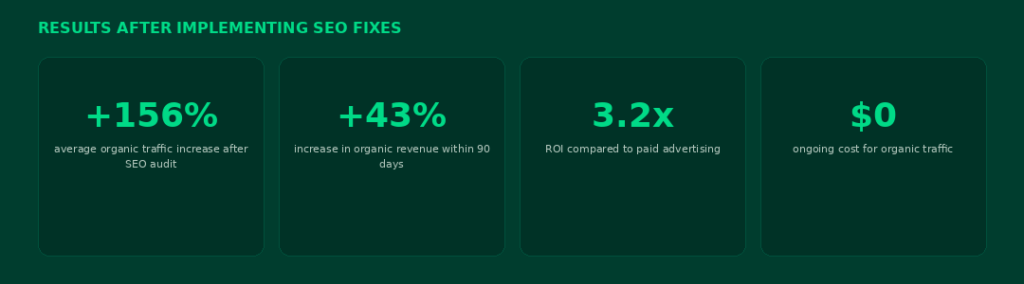
The results speak for themselves. Stores that implement the fixes from our SEO audit typically see a 156% increase in organic traffic within 6 months. Organic revenue increases by 43% within 90 days. And the ROI compared to paid advertising is 3.2x because once you rank, the traffic costs nothing.
The best part is that most of these fixes are one-time efforts. You fix your meta titles once. You add structured data once. You compress your images once. Then the traffic compounds month after month without any ongoing ad spend.
How to Get Your Free Shopify SEO Audit
We are building a free tool that lets you paste your Shopify store URL and get an instant SEO audit report covering all 10 dimensions above. Score out of 100. Specific issues identified. Exact recommendations to fix each one.
In the meantime, we offer a manual version as part of our free store audit. We score your store across 30+ dimensions (SEO is just one of them) and deliver a full report within 48 hours.
Want your free audit? Book a 30-minute call
We will score your store, show you every gap, and give you a prioritized roadmap to fix them. No commitment required you keep the report regardless.
Beyond SEO: The Full Automation Picture
SEO is one piece of the puzzle. Most Shopify stores we audit have gaps across 8-12 dimensions beyond SEO abandoned cart recovery, ROAS visibility, customer support, email automation, inventory management, and more.
That is why we do not just fix SEO. We build a complete AI automation system that handles everything: SEO blog content generated automatically, product listings optimized with AI, customer support handled by chatbots, cart recovery running on autopilot, and ROAS dashboards showing true profit across every ad channel.
One system. Fully automated. You own it forever.
Start with the free audit. See the full picture. Then decide what to automate first.